road traffic safety
Actions for the Public Health Sector
to improve Road Traffic Safety Final Statement March 2005
Task force on Road Safety
of the Working Party on
Accidents and Injuries
(Public Health Programme 2003-2008)
Edited by Rupert Kisser, Claudia Körmer, Mathilde Sector
Thank you to Francesca Racioppi, Delia Alexe and Eleni Petridou for their substantial contribution
March 2005
Content
- Members of the Task Force
- Mission of the task force
- Why is road safety an important issue for the Public Health sector?
- Added value by the involvement of the Public Health Sector
- Road traffic injury risks
- Focus on vulnerable road users
- Data on external causes
- Public health policy
- Recommendations for DG SANCO
- Appendix
- References
- Footnotes
Members of the Task Force
| Name | Country |
| Kisser, Rupert (Task Force leader) | AT |
| Antoniades, Costas | CY |
| Benesova, Veronika | CZ |
| Benyi, Maria | HU |
| Detogni, Claudio | IT |
| Karski, Jerzy | PL |
| Nunes, Baltazar | PT |
| Pace-Asciak, Renzo | MT |
| Petridou, Eleni | GR |
| Rok-Simon, Mateja | SI |
| Racioppi, Francesca | WHO Europe |
| Schelp, Lothar | SE |
| Sethi, Dinesh | WHO Europe |
| Wagener, Yolande | LU |
Mission of the task force
The DG SANCO of the European Commission initiated a task force on road safety in the framework of the „Working Party on Accidents and Injuries“ in December 2003. This task force shall give recommendations to the European Commission/DG SANCO how the issue of road safety from a public health point of view can be supported by DG SANCO. A list of actions shall be provided to DG SANCO to provide technical contributions to defining the contents of the Public Health Programme 2005 to 2008, as well as other departments of the European Commission, the National Competent Authorities, the European parliament and the European council.
This report is considered as a summary of road safety strategies. Its aim is to summarize recommendations for the EU public health sector in order to address the issue of road safety within this sector.
Why is road safety an important issue for the Public Health sector?
Accidents and injuries in the field of road traffic are a major public health problem in the world and also in Europe. Road traffic injuries account for one quarter of the global burden of injuries1. The World Health Organization (WHO) estimates road injuries will rank in sixth place among the leading causes of death and burden of disease in 20201. The WHO Global Burden of Disease 2002 database shows that about 10% of people dying worldwide because of a road injury are dying in Europe1. Almost 40.000 persons were killed and about 1,725,500 injured in 2001 in the 15 EU Member States2. Traffic injuries are a leading cause of death in the age group between 15 and 29 years of age3 and the leading causes of death among children 5-14 years old in Europe. Older pedestrians account for nearly half of all pedestrian fatalities in Europe4.
Important health disparities exist between the New Member States and the EU-15 in road traffic injuries. There is almost a 10-fold greater risk of dying in a road accident in Lithuania and Latvia as compared to Sweden4. Also an estimated 200,000 families per year were ----affected by the death or life-long disability of a family member4.
The European Transport Safety Council estimates the costs of road traffic injuries to society in the EU to be 180 billion Euros per year5. The direct medical costs per patient due to a road injury are about 600 Euro in the Euro region.
Key factors for road traffic injuries and their consequences for society are6:
- Speeding (about one third of the fatal and serious accidents). Limiting excessive speed would reduce the number of people killed annually in the EU by 11 000 and of people injured by 180 0007)
- Driving under influence of alcohol (about 10 000 deaths annually in the EU8).
- Under-utilization of seat belts and child restraints (10 000 car occupants died in an accident because they did not wear their seat belt over the year 19969)
- Poor road designs and roadway environment
- Unsafe vehicle design (car fronts)
- Under-implementation of road safety standards
- Poor enforcement of road safety regulations
The first three factors listed above are the main causes of deaths on the roads in Europe.
Below is a summary of the evidence-based measures to reduce road traffic injuries on a national and international level, from the WHO World report on road traffic injury prevention:
- Engineering: The improvements of road safety assessments, automotive engineering through e.g. seat belts, airbags etc. to reduce the consequences of accidents,
- Environment: Traffic calming, road infrastructure changes (separating pedestrians and cyclists from motorized traffic) as well as telematics to construct traffic environments that prevent wrong behaviours of drivers,
- Education: Traffic education including skills training in the road environment and improved driving licence training to teach road users safe behaviour in road traffic (weak evidence exists of other educational interventions to change human behaviour),
- Enforcement: Legislation and enforcement to govern co-operations in traffic without conflicts as well as safety standards.
- Evaluation: evaluation of measures concerning their effectiveness to prevent injuries has been systematically reviewed for some of these measures.
Added value by the involvement of the Public Health Sector
The work of the public health sector is framed within the public health approach of data collection, research, prevention, evaluation, policy, services and advocacy.
Road traffic injury risks
In Western Europe there is a decline in road traffic-related deaths4. Although all types of road users are at risk of having a traffic accident, pedestrians and two-wheeler users are at greater risk of dying than vehicle drivers and occupants3. Less information exists about non-fatal injury risks as these data are not routinely collected. Police data in most countries in Europe provide reliable and detailed data about accidents involving a moving vehicle, but there is considerable under reporting of non-collision accidents, especially those involving pedestrians and cyclists10 . From the public health point of view there is no adequate reporting of all road-related injuries.
The collection of more detailed data on identifying and monitoring risk factors (e.g. excess speeds, drinking while driving) could be integrated within existing public health databases. Furthermore, systematic reviews are needed to determine the effectiveness of existing interventions to reduce these risk factors.
Focus on vulnerable road users
Vulnerable road users are defined by the Organisation for Economic Co-operation and Development as “those unprotected by an outside shield, namely pedestrians and two-wheelers”11. This task force would also highlight within this definition those groups that have added risks: children, elders, and persons with a disability.
Children can not estimate speed and risks and are often too small to see cars and their drivers early enough. Thus they are at an especially high risk in road traffic, and are unable to cope with difficult traffic environments till about 10 years of age. That is why they are considered to be the most vulnerable road users4.
Also, elderly people are considered to be vulnerable road users as they have a gradual decreased ability to cope with complex traffic situations, and are physically more fragile with age, thus suffering more severe consequences in the event of an injury. That is why they account for nearly half of all pedestrian fatalities in European OECD countries.
Persons with disabilities refers to individuals with a physical, sensory or mental impairment that are limited in full participation due to environmental barriers in society, specifically for the purposes of this report, within the road traffic environment. The Commission has recognized that it is a basic right of persons with disabilities to live in a barrier-free environment, and have the same protection as that of others12.
Thus, although cyclist, pedestrians, playing children, elderly, persons with disabilities (blind, deaf, persons with wheelchairs) have a greater risk of mortality than other road users, policy areas in the prevention of road traffic injuries engage mainly in the improvement of road traffic from the perspective of motorised road traffic users4. The recent the project “Promotion of measures for vulnerable road users –PROMISING” funded by DG transport recommends mainly road structure improvements and enhanced vehicle design to protect vulnerable road users13. Vulnerable road users have less influential lobbies and cause little risk to other road users, therefore they are often unheard. Also, the huge burden of falls on public roads and other injuries have hardly been recognized. Vulnerable road users must therefore be a special focus for the public health sector of the European Commission14.
Data on external causes
Databases such as CARE (Community database on Accidents on the Roads in Europe) and IRTAD (International Road Traffic and Accident Database) collect data on road traffic deaths and injuries, based on detailed data on individual accidents as collected by Member States. Much of the data reported from Member States to IRTAD or CARE are registered by the police. It is known that the number of collisions without counterpart e.g. injuries of children and seniors as pedestrians and bicyclists, are much higher than those reported to the police10. It exceeds even the number of people injured by motor vehicle crashes.
Another source of data is the European Injury Database (IDB) which contains some data on injuries on public roads without counterpart, and will register systematic information on causes, course of events and consequences of traffic accidents in the near future.
Thus, up to now no systematic data exists on post-injury care or resulting disability due to road traffic injuries to vulnerable road users. Because these consequences of road traffic are not reported in routine statistics and are therefore hardly addressed by road traffic related policy decisions. The United Nations is supporting research on capturing disability data systematically around the world—hopefully this will be a source of data in the future. Data on these topics must be promoted within the injury prevention research community. The major existing data sources need to be analysed in order to produce a detailed report on the burden of road traffic injuries sustained by vulnerable road users, including trends. It is imperative that the road traffic injury data systems be improved upon and that each Member State makes an effort to provide high quality data at the national level.
Public health policy
Generally, the reduction of road traffic injuries, including injuries in non-motorized transport, should be included in programmes of the national and international public health sector. These efforts should be connected to campaigns conducted by the transport and other responsible sectors. The public health sector should support these efforts with evidence-based arguments, and should pay special attention to the safety needs of vulnerable road users. Duplication of work has to be avoided, but additional value should be created.
Recommendations for DG SANCO
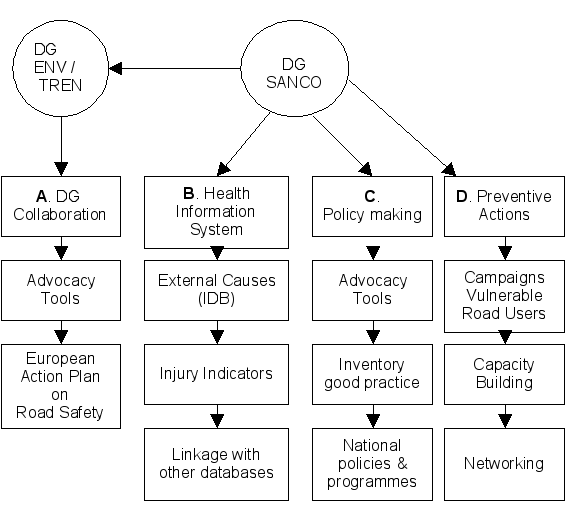
An effective road safety strategy for the protection of vulnerable road users is multi-faceted, based on the following components: advocacy, injury surveillance; the use of injury indicators; and policy actions (see Figure 1 on page 19 for a visual representation of the role DG SANCO may have in road safety).
Listed below are public health recommendations for DG SANCO on the issue of road safety in Europe:
A. Intersectoral collaboration with DG TREN
- Convene a technical meeting of experts, from the health sector and transport sector, who would be invited to take stock from the background provided by the task force report and advise on next steps, taking into account the need to provide value added to activities which are already taking place in the Region. An effort should be made to frame the activities within international commitments: the World Health Assembly Resolution on Road Safety and Health (WHA57.10 May 2004), the Children’s Environment and Health Action Plan for Europe (EUR/04/5046267/7 25 June 2004) and Declaration (EUR/04/5046267/6 25 June 2004) and European commitments: Directorate General for Transport-research and European Road Safety Action Programme (Halving the number of road accident victims in the European Union by 2010: A shared responsibility, COM(2003) 311 final), and the European Traffic Safety Council. Collaboration with DG Environment is also needed.
- Promotion of traffic calming measures by the health and transport sector together for changes in road infrastructure and urban planning (e.g. separating pedestrians and cyclists from motorized traffic) as well as 30km/h zones, elder driver safety assessments and re-orientation of the transport demand towards safer transport modes4.
- Promotion of alternative modes of transportation by the health and transport sector by showing that public transport, cycling and walking have positive effects to the health and should be promoted from a public health point of view. In many environments (inner cities e.g.) these forms of transportation provides additional physical exercise, reduce air pollution, and reduces the risk of fatal car crashes. Motorised road traffic carries people from the place of departure to their destination individually, but account at the same time for polluting the air, noise – in addition to the high numbers of injuries. The WHO report about road safety in Europe notes the harmful effect of physical inactivity to societies` health caused by using motorised vehicles4. It is necessary to look at advantages and losses for public health and reflect traffic modes accordingly4. Environmental conditions to support the safe usage of alternative modes of transport have to be focused on.
- Ensure that vulnerable road users are adequately addressed in the implementation of a European Action Plan on Road Safety from a public health point of view, and harmonisation of this plan with existing DG TREN strategies. This plan should set measurable five year targets, should summarize actions in order to meet these goals and should identify responsible institutions. Accompanying partnership with experts of DG TREN should be established.
B. EU Health Information system
The following improvements would be necessary within the EU Health Information System:
Injury Surveillance System
- External causes of road injuries: ICECI Coding for non-fatal road injuries is not yet documented by most of the EU-Member States. Through an enlargement of the IDB to road traffic injuries according to ICECI, additional information on course of events etc. will soon be made available for road traffic injuries on a European level. This is needed to have a more comprehensive view on injury causes and consequences. This information should be included in European reports.
- Comprehensive view on road injuries: To minimize the underreporting of road injuries a compilation of the injury data in CARE (Community Road Accident Database)15, IDB and Hospital Discharge Register must be combined to give a comprehensive view on injuries of all road users, including all injuries without counterpart, deaths, disabilities and hospital patients.
- Harmonised data collection: In order to enhance harmonisation of road injury data collection between transport and public health sectors, regular exchange of information between CARE and IDB administration is recommended, to link hospital data with police-based data. This will be done with the input from the Member States.
- Easy central data access: This compilation of data should be easily accessible and be actively promoted at e.g. the health portal of the DG SANCO. This will be done with the input from the Member States.
Injury indicators
A systematic overview about the scope of injuries, especially disabilities and costs for Europe serves as a basis for comparing developments of injury incidences over time, injury changes by Member State and international comparisons according to national policies.
- Public health oriented road injury indicators: Road injury indicators for the revised road injury definition (including also non-motorized mobility and public transport) should be included in the list of European Community Health Indicators (ECHI) of DG SANCO.
- Revised road traffic indicators: By using additional IDB data on road traffic injuries underreporting by the police could be amended in order to obtain a more realistic indicator for road injuries.
- Disability indicators: As the disability rate due to road traffic injuries is especially high compared with other injuries road injury disability indicators should be developed on the basis of routine health data for regular reporting and benchmarking (similar to the AIS - Abbreviated Injury Severity Scale based on ICD diagnosis). (In addition to the indicators already used in epidemiology such as: DALYs - Disability adjusted Life Years, YLD - Years Lost due to Disability)16.
- Injury risk indicators: In order to obtain injury risk indicators based on exposure data on frequency of transport modes (private and public transport) and overall mobility should be included in the ECHI list of indicators as well.
- Quality of life: Quality of life measures (e.g. perception of health, satisfaction with life etc.) of persons having suffered a road traffic crash are important to use because they capture various domains of a persons functioning, physical domain, psychosocial, adaptive etc. Studies in this field show that significant psychological distress following road traffic crashes is common4. Respective qualitative data using health related quality of life tools should be collected regularly by each EU Member State.
- The cost effectiveness of prevention measures should be taken into account as already stated in the report “Costs-Benefit Analysis of Road Safety Improvements”17. In the SWOV report “Economic evaluation of road safety measures” two evaluation methods called “monetary methods” are described: the cost benefit analysis (CBA) and the cost-effectiveness analysis (CEA). Direct and indirect effects of measures such as increased safety feeling of people or air pollution as well as running and maintenance costs have to be also considered in the evaluation of road safety measures18. The report “Costs-Benefit Analysis of Road Safety Improvements” is analysing measures such as speeding, drunk driving and non-use of seat belts by value of lives saved, injuries avoided, property damage costs etc. Implementation of the proposed measures would not only safe lives, but also add to the productivity of society17. Models for comprehensive cost-effective decision making for road traffic-related injuries are also needed.
- Research and innovation: Support research and innovation for best practise strategies to reduce morbidity and mortality due to road traffic.
C. DG SANCO Policy Making
Actions by DG SANCO should concentrate on activities which are not the responsibility of other European institutions, which cannot be taken on national level, and which provide an additional European value. Generally, such actions are: facilitation of actions on national level (e.g. by information clearing on good practices available, dissemination of this information, support of network building, standardisation of programmes, providing specific tools for administrations and other stakeholder, additional European campaigns on certain issues to highlight their relevance). In particular, the following European public health actions on road safety should be considered:
- Identification of stake holders: The key stake holder groups and their focal points in Europe should be identified, also their specific opportunities and responsibilities, as well as their information needs regarding road safety for vulnerable road users. This would facilitate actions of concerned governmental sectors (health administration, social security sector, communities etc.) but also of influential non-governmental interest groups (child protection groups, senior citizens organisations, bicyclists interest groups, health promotion agencies, and particularly victims organisations etc.).
- Advocacy Tools: Development and distribution of advocacy documents in order to provide convincing arguments for the inclusion of traffic safety issues for vulnerable road users in public health policy and programmes, as well as for transport and other sectors, in order to intensify the inclusion of vulnerable road users in road safety programmes. These documents should provide public health arguments, which are not yet well established, e.g. epidemiological aspects and health indicators.
- Inventories of good practice: review existing systematic reviews of the effectiveness of different intervention strategies (behavioural, environmental, etc.) and identify interventions which have not yet been reviewed and assess their effectiveness, including case studies. These findings would serve as the content of a policy-oriented manual that is current and evidence-based. This tool shall be developed within the Work package 5 “Initiatives for interventions of the Public Health Sector to prevent accidents among vulnerable road users” part of the “APOLLO: Strategies and Best Practices for the Reduction of Injuries” project submitted to the EC according to the Public Health Work Plan 2004. The aim is to assist the European Commission in guiding Member Sates to implement evidence-based strategies.
- Usage of formal distribution channels: Formal dissemination of advocacy tools and information to the member state administrations and European Parliament about the European public health actions on traffic safety and the policy recommendations, via conferences, expert meetings, web board, newsletters, etc.
- Promote national road safety plans: The transport and public health sector should work together to promote national policy actions. But also actions by other relevant sectors (law enforcement, education, welfare, economy) should be aligned in order to achieve reductions of road injury risk. The WHO recommends in their European road safety report to identify a lead agency in government to guide and prepare a national road safety strategy and plan for action, allocate resources, implement specific actions and support the development of national capacity and international co-operation4.
D. Prevention Actions
- Focus on Vulnerable Road Users: a European multi-faced intervention to target pedestrians and bicyclists in the road environment is needed, with a special focus on children and elders. The key message is for all of those in and around the roads to keep children and elders mobile, but safe.
- Capacity building: The public health sector should implement basic knowledge on injury prevention in general and traffic safety in particular in its professional training, of medical doctors, nurses, public health advisors etc. The content of basic knowledge should be defined at the European level. An interdisciplinary approach is needed for this, with collaboration with other working parties of the Commission.
- Inclusion in health promotion: Mainstream road safety objectives should be integrated into the public health agenda, also in the member states. Road injury prevention – like injury prevention in general – should be included in health promotion programmes. For the time being, there are numerous activities all over Europe on health promotion but – in spite of the fact that injuries are a major health problem – injuries are usually excluded. The inclusion of injury prevention on a national level can be done by national health administrations, which frequently set guidelines (or legislation) for financing health promoting activities, in order to change attitudes and behaviours regarding risky road behaviours and at the same time promoting road safety.
- Delivery of health care: Relevant public health services are key stakeholders in prevention and treatment of road traffic injuries. A review is needed of the role of pre-hospital care and practices in order to identify good practices in this area, specifically time to hospital and quality of care at the crash site. Additionally, medical and psychological assessments on a person’s ability to drive should be performed to a greater extent, especially for the safety of older persons. The health sector plays an integral part in disseminating health information to patients. Hospitals are a unique location for health promotion. Discussion with the health sector is needed to establish guidelines on how health structures can promote road safety for their employees and clients.
- Evaluation of programmes: For a continuing improvement of the road traffic situation the implemented measures should be evaluated regarding effectiveness and sustainability using available health indicators. The health sector can take a leading role in the formulation of health objectives and controlling of changes by using health indicators. This gives a strong voice to the health sector.
Appendix
Figure 1. Role of DG SANCO in Road Safety
Key documents of the European Commission/DG Transport
- White book, European Transport policy for 2010, Time to decide, European Commission, Luxembourg 2001
- Saving 20.000 lives on our roads, A shared responsibility, European Road Safety Action Programme, European Commission, Belgium 2003
- Road Safety, Results from the transport research programme, European Commission, Belgium 2001
- Costs-Benefit Analysis of Road Safety Improvements . Final Report, 12 June 2003 by the ICF Consulting and the Imperial College Centre for Transport Studies, UK.
- SARTRE - Social Attitudes to Road Traffic Risks in Europe project. Survey results that focus on the attitudes of European citizens to the three main causes of road fatalities: speed limits, wearing seat belts, and alcohol use.
- Information gathering on speeding, drink driving and seat belt use in the member states. Final Report, Part I and II, May 2003 by Clifford Chance.
- DG SANCO established the Strategy Paper “Actions for a safer Europe” (2004)
- The UN General Assembly established the Global Road Safety Crisis Report
- WHO-Geneva summarised traffic injury events and their prevention measures within the „World Report on road traffic injury prevention (2004)“
- WHO-Europe focused within the report „Preventing road traffic injury: a public health perspective for Europe“ on road traffic injuries in the European region (2004)
- OECD established a report and policy brief “Keeping children safe in traffic” recommending countries to implement a series of measures to address this issue (2004) http://www.oecd.org/dataoecd/27/25/31859113.pdf
- OECD report “Safety of vulnerable road users” presents a review of the current safety situation of vulnerable road users in OECD Member countries (2001)
- Resolution on road safety and health of the World Health Assembly to address the lack of safety on the world's roads (2004)
References
Actions for a safer Europe, Strategy Paper established by DG SANCO, Luxembourg 2004
Costs-Benefit Analysis of Road Safety Improvements, Final Report, ICF Consulting, Ltd. & Imperial College Centre for Transport Studies. London, June 2003
Economic evaluation of road safety measures, SWOV Institute for Road Safety Research, Paul Wesemann, Leidschendam, 2000
IPP Report: A surveillance based assessment of medical costs of injury in Europe: Phase 2, Final Report, co-ordinated by Consumer Safety Institute for DG SANCO, Amsterdam, 2004
IPP Report: Comprehensive View on European (HLA) Injury Data, co-ordinated by Institute “Sicher Leben” for DG SANCO, Vienna 2003
The injury chart book, a graphical overview of the global burden of injuries, Department of Injuries and Violence prevention, WHO Geneva, 2002
Transport Safety Performance in the EU: A Statistical Overview, European Transport Safety Council, Brussels, 2003
Preventing road traffic injury: a public health perspective for Europe, WHO/Europe, Copenhagen 2004
Priorities for child safety, agenda for action, European Child Safety Alliance, ECOSA, Amsterdam, 2004
PROMISING, Promotion of Measures for Vulnerable Road Users, SWOV, funded by EC/DG Transport, Netherlands 2001
Road Traffic Injuries, Fact sheet, WHO, Geneva
Unfallstatistik 2003, Kuratorium für Verkehrssicherheit, Heft 36, Wien, März 2004
Weissbuch, Die europäische Verkehrspolitik bis 2010, Weichenstellungen für die Zukunft, Luxembourg 2001
World report on road traffic injury prevention, WHO, Geneva 2004
EC Care database:
http://europa.eu.int/comm/transport/care/
WHO, Burden of Injuries project: http://www3.who.int/whosis/menu.cfm?path=evidence,burden,burden_estimates&language=english
Footnotes
1The injury chart book, a graphical overview of the global burden of injuries, Department of Injuries and Violence prevention, WHO Geneva, 2002.
2
European
Commission. Directorate General for
Transport-Road Transport: Road Safety. Accessed November 2004.
http://europa.eu.int/comm/transport/road/roadsafety/index_en.htm
3 World report on road traffic injury prevention, WHO, Geneva 2004.
4 Preventing road traffic injury: a public health perspective for Europe, WHO/Europe, Copenhagen 2004.
5 Transport Safety Performance in the EU: A Statistical Overview, European Transport Safety Council, Brussels, 2003, page 76 Road Traffic Injuries, Fact sheet, WHO, Geneva, 2004.
7 ETSC report ‘Reducing traffic injuries resulting from excess and inappropriate speed’, Jan.1995, saying that an average speed reduction of 5 km/h should result in a reduction of over 11.000 fatal casualties annually in the EU (based on IRTAD, 1994).
8 Commission Recommendation of 17.01.2001 (OJ C 48/2), paragraph 1.2.2.
9 ETSC report on police enforcement, May 1999.
10 Hvoslef H. Under-Reporting of road traffic accidents recorded by the police, at the international level. Operational Committee of IRTAD and Norwegian Public Roads Administration, Oslo. Norway, 1994.
11 Scientific Expert Group on the Safety of Vulnerable Road Users (RS7-98). Safety of Vulnerable Road Users, OECD, 1998.
12 Equal Opportunities For People With Disabilities: A European Action Plan, Com(2003) 650 Final, Brussels, 30.10.2003.
13 PROMISING, Promotion of Measures for Vulnerable Road Users, SWOV, funded by EC/DG Transport, Netherlands 2001
14 Actions for a safer Europe, Strategy Paper established by DG SANCO, Luxembourg 2004.
15 The database CARE was built to quantify road safety problems and provides compared to other road injury databases a high level of disaggregation:
http://europa.eu.int/comm/transport/care/
16 http://www3.who.int/whosis/menu.cfm?path=evidence,burden,burden_estimates&language=english
17 Costs-Benefit Analysis of Road Safety Improvements, Final Report, ICF Consulting, Ltd. & Imperial College Centre for Transport Studies. London, June 2003
18 Economic evaluation of road safety measures, SWOV Institute for Road Safety Research, Paul Wesemann, Leidschendam, 2000, page 17ff