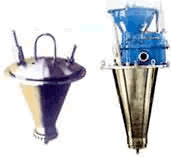
 |
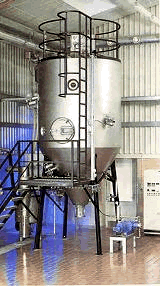
The spray drying is the technology widest used in the
liquid technology shaping and in the drying industry. The drying technology
is most suitable for producing the powder, particle or block solid
products from the materials, such as: solution, emulsion, soliquoid
and pumpable paste states, For this reason, when the particle size
and distribution of the final products, their residual water contents,
the stacking density and the particle shape must meet the precision standard, the spray drying is one of the most desired technologies. |
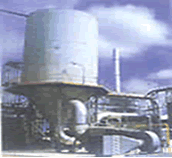 |
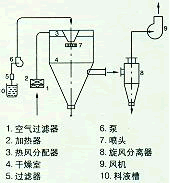
| After the filtering and heating,
the air enters into the air distributor on the top of the drier. The
hot air enters into the drying room in the spiral form and uniformly.
By passing through the high-speed centrifugal spray on the top of
the tower, the material liquid will rotate and be sprayed into the
extremely fine mist liquid beads. Through the very short time of contacting
the heat air, the materials can be dried into the final products.
The final products will be discharged continuously from the bottom
of the drying tower and from the whirl separator. The waste gas will be discharged from blower. |
 |
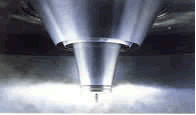 |
At a high speed of drying, after the spraying of the
material liquid, the surface area of the material will be increased
greatly. In the hot-air flow,95%-98% of water can be evaporated at
a moment. The time of completing the drying needs only several seconds.
This is especially suitable for drying the heat sensitive materials. Its final products own the good uniformity, mobility, dissolving capacity, And the final products are high in their purity and good in their quality. The production procedures are simple and the operation and control are easy. The liquid with the moisture contents 40-60%(for special materials, the contents may reach 90%).can be dried into the powder or particle products once a time. After the drying, there is no need for smashing and sorting, so as to reduce the operation procedures in the production and to enhance the product purity. The product particle diameters, looseness and water contents can be adjusted through changing the operation condition in a certain scope. It is very convenient to carry out the control and management. |
|
 |
 |
 |
- Materials that should be known before the
order
Particle liquid name and material property: solid contents(or water contents),viscosity, surface tension and PH value.
- Powder material contents after the drying, permissible residual water contents, particle size, and permissible maximum temperature.
- Output: shift time daily.
- Energy that can be supplied: steam pressure supply capacity, electricty capacity, fuel coal, oil and air capacity.
- Control requirement: whether or not the inlet and outlet temperatures should be controlled.
- Powder collection requirement: whether or not the bag type collector should be mounted and what is the requirement of the environment for discharging the exhausted gas.
- Other special requirements.
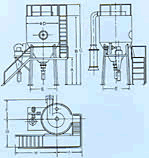
| Size |
A |
B |
C |
D |
E1 |
E2 |
F |
G |
H |
I |
| LPG-25 |
1290 |
3410 |
4260 |
1800 |
1200 |
1200 |
1000 |
1700 |
1300 |
1550 |
| LPG-50 |
1730 |
4245 |
4645 |
2133 |
1640 |
1640 |
1250 |
1750 |
1800 |
1600 |
| LPG-100 |
2500 |
5300 |
6000 |
2560 |
2100 |
2100 |
1750 |
1930 |
2600 |
1780 |
| LPG-150 |
2800 |
6000 |
6700 |
2860 |
2180 |
2180 |
1970 |
2080 |
3050 |
1960 |
| LPG-200 |
2800 |
6600 |
7300 |
3200 |
2300 |
2300 |
2210 |
2250 |
3050 |
2100 |
| LPG-300 |
2800 |
8000 |
8700 |
3700 |
2800 |
2800 |
2520 |
2400 |
3050 |
2250 |
|
item |
LPG |
|||||
| 5 |
25 |
50 |
100 |
150 |
200-2000 |
|
| inlet temperature |
automatically controlled |
|||||
| outlet
temperature |
~80-90 |
|||||
| Max.water evaporation capacity |
5 |
25 |
50 |
100 |
150 |
200-2000 |
| centrifugal spraying nozzle transmission
mode |
compressed air transmission |
Mechanical transmission |
||||
| Rotation speed |
25000 |
18000 |
18000 |
18000 |
15000 |
8000-15000 |
| sprayingdesc diameter |
50 |
100 |
120 |
140 |
150 |
180-340 |
| Heat supply |
Electricity |
Electricity+steam |
Electricity+steam,fuel oil and gas |
Settled by users themselves |
||
| Max.Electric heating power |
9 |
36 |
63 |
81 |
99 |
|
| overall dimensions |
1.8×0.93 |
3×2.7 |
3.7×3.2 |
4.6×4.2 |
5.5×4.5 |
Decided according to teh concrete conditions |
| Dried powder restoring rate |
≥95 |
≥95 |
≥95 |
≥95 |
≥95 |
≥95 |