


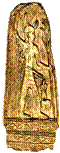

Canaanite
& Phoenician History & Culture


Between the period of 1200 B.C. and 900 B.C. there was no major military
power in Mesopotamia. Therefor smaller states like Phoenicia and the Hebrew kingdom were able
to prosper. These kingdoms especially the Phoenicians started to trade throughout the
Mediterranean region.
Sardinia Cyprus, and Carthage-most important and lasting colony By far they were superior to all peoples of that time in seamanship. Legend has it that an Egyptian pharaoh hired a band of Phoenicians to map and circumnavigate the coast of Africa. They are best remembered for their contributions in the establishment to trade with the many peoples living along the Mediterranean Sea. The Greeks received their alphabet from them as late as the 10th century B.C. or as early as the 15th. Other antiquities famed to the Phoenicians include carved ivories to be used in furniture, metalwork, and especially glassware.
Crescent is roughly an arc-shaped area which stretches from the mouth of the Tigris and Euphrates rivers at the Persian Gulf, west to the Red Sea. About 5,000 years ago it was inhabited by a race know as Semites. The Semites who lived in the eastern portion of the Fertile Crescent were Sumerians, Assyrians, and Babylonians. In the western portion lived the Amorites. Those Amorites who settled in what are today Lebanon, Syria, and Israel were know as Canaanites. Later, the Greek called them Phoenicians.
Phoenicia
(foh-NEE-shee-ah) Phoenicia is the Greek name for the country and people living on
the coast of Syria in ancient times at the east end of the Mediterranean Sea. It is
believed that economic opportunity and population pressures forced
them out into the seas. The Phoenicians colonized many areas along the
Mediterranean Sea. Areas where their colonies have been found:
Sardinia Cyprus, and Carthage-most important and lasting colony By far they were superior to all peoples of that time in seamanship. Legend has it that an Egyptian pharaoh hired a band of Phoenicians to map and circumnavigate the coast of Africa. They are best remembered for their contributions in the establishment to trade with the many peoples living along the Mediterranean Sea. The Greeks received their alphabet from them as late as the 10th century B.C. or as early as the 15th. Other antiquities famed to the Phoenicians include carved ivories to be used in furniture, metalwork, and especially glassware.
THE PHOENICIANS ROUTES OF
THE PHOENICIANS The Fertile
Crescent is roughly an arc-shaped area which stretches from the mouth of the Tigris and Euphrates rivers at the Persian Gulf, west to the Red Sea. About 5,000 years ago it was inhabited by a race know as Semites. The Semites who lived in the eastern portion of the Fertile Crescent were Sumerians, Assyrians, and Babylonians. In the western portion lived the Amorites. Those Amorites who settled in what are today Lebanon, Syria, and Israel were know as Canaanites. Later, the Greek called them Phoenicians.