[Saussure introduces the structuralist point of view into linguistics which is marked first of all by giving special relief to the synchronic dimension in the study of language. The synchronic dimension is distinguished from the diachronic, that is, historic. The idea is that an account of the present meaning of words and sentences, i.e. semantics, can't be reduced to a historical study. This may seem obvious to us, but the study of linguistic meaning prior to Saussure had been historical with considerations of structure limited largely to a consideration of grammar. The idea is that meaning, or signification, depends on the SYSTEM of language given by a number of laws of equilibrium which constitute the relative systemic stability of linguistic meaning at the moment when, in virtue of this system, one speaks. So we have the distinction between la langue and la parole. Language is the articulated use of the system, la langue in speech, la parole. La langue is language minus la parole. It is difficult to overestimate the significance of Saussure's idea for a whole generation of French thinkers. For insofar as language enters into the determination of a whole variety of social phenomena, its effects as structure enter in as well. Post structuralist thinkers remain in debt to Saussure for however dynamic and open-textured structures come to be, one can't go back to purely historical modes of interpretation. The structuring effects of discourse, the agency of the letter in Lacan's terms, must be taken into account.]
1. Sign, Signified, Signifier
Some people regard language, when reduced to its elements, as
a naming-process only‹a list of words, each corresponding to the
thing that it names. For example:
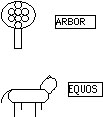
This conception is open to criticism at several points. It assumes
that ready-made ideas exist before words (on this point, see below,
p. 111); it does not tell us whether a name is vocal or psychological
in nature (arbor, for instance, can be considered from either view-
point); finally, it lets us assume that the linking of a name and a
thing is a very simple operation‹an assumption that is anything
but true. But this rather naive approach can bring us near the
truth by showing us that the linguistic unit is a double entity, one
formed by the associating of two terms
We have seen in considering the speaking-circuit (p. 11) that both terms involved in the linguistic sign are psychological and are
united in the brain by an assocative bond- This point must be
emphasized.
The linguistic sign unites, not a thing and a name, but a concept
and a sound-image.[l] The latter is not the material sound, a purely
physical thing, but the psychological imprint of the sound, the
impression that it makes on our senses. The sound-image is sensory,
and if I happen to call it "material,"' it is only in that sense, and by
way of opposing it to the other term of the association, the concept,
which is generally more abstract.
The psychological character of our sound-images becomes ap-
parent when we observe our own speech. Without moving our lips
or tongue, we can talk to ourselves or recite mentally a selection of
verse. Because we regard the words of our language as sound-
images, we must avoid speaking of the "phonemes" that make up
the words. This term, which suggests vocal activity, is applicable
to the spoken word only, to the realization of the inner image in
discourse. We can avoid that misunderstanding by speaking of the
sounds and syllables of a word provided we remember that the
names refer to the sound-image.
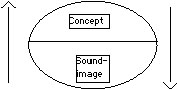
The linguistic sign is then a two-sided psychological entity that
can be represented by the drawing:
The two elements are intimately united, and each recalls the
other. Whether we try to find the meaning of the Latin word arbor
or the word that Latin uses to designate the concept "tree," it is
1. The term sound-image may seem to be too restricted inasmuch as beside
the representation of the sounds of a word there is also that of its articulation,
tbe muscular image of the phonational act. But for F. de Saussure language is
essentially a depository, a thing received from without (see p. 13). The sound
image is par excellence the natural representation of the word as a fact of
potential language, outside any actual use of it in speaking. The motor side is
thus implied or, in any event, occupies only a subordinate role with respect
to the sound-image. [Ed.]
clear that only the associations sanctioned by that language appeal
to us to conform to reality, and we disregard whatever others
might be imagined.
Our definition of the linguistic sign poses an important question
of terminology. I call the combination of a concept and a sound-
image a sign, but in current usage the term generally designates
only a sound-image, a word, for example (arbor, etc.). One tends
to forget that arbor is called a sign only because it carries the con-
cept "tree," with the result that the idea of the sensory part
implies the idea of the whole.
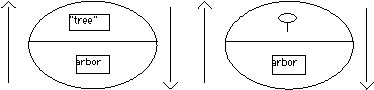
Ambiguity would disappear if the three notions involved here
were designated by three names, each suggesting and opposing the
others. I propose to retain the word sign [signe] to designate the
whole and to replace concept and sound-image respectively by
signified [signifié] and signifier [signifiant]; the last two terms have
the advantage of indicating the opposition that separates them
from each other and from the whole of which they are parts. As
regards sign, if I am satisfied with it, this is simply because I do not
know of any word to replace it, the ordinary language suggesting
no other.
The linguistic sign, as defined, has two primordial character-
istics. In enunciating them I am also positing the basic principles of
any study of this type.
2. Principle 1: The Arbitrary Nature of the Sign
The bond between the signifier and the signified is arbitrary.
Since I mean by sign the whole that results from the associating of
the signifier with the signified, I can simply say: the linguistic sign
is arbitrary.
The idea of "sister" is not linked by any inner relationship to
the succession of sounds s-ö-r which serves as its signifier in French;
that it could be represented equally by just any other sequence is
proved by differences among languages and by the very existence
of different languages: the signified "ox" has as its signifier b-ô-f
on one side of the border and o-k-s (Ochs) on the other.
No one disputes the principle of the arbitrary nature of the sign,
but it is often easier to discover a truth than to assign to it its
proper place. Principle I dominates all the linguistics of language;
its consequences are numberless. It is true that not all of them are
equally obvious at first glance; only after many detours does one
discover them, and with them the primordial importance of the
principle.
One remark in passing: when semiology becomes organized as
a science, the question will arise whether or not it properly includes
modes of expression based on completely natural signs, such as
pantomime. Supposing that the new science welcomes them, its
main concern will still be the whole group of systems grounded on
the arbitrariness of the sign. In fact, every means of expression used
in society is based, in principle, on collective behavior or‹what
amounts to the same thing‹on convention. Polite formulas, for
instance, though often imbued with a certain natural expressive-
ness (as in the case of a Chinese who greets his emperor by bowing
down to the ground nine times), are nonetheless fixed by rule; it is
this rule and not the intrinsic value of the gestures that obliges one
to use them. Signs that are wholly arbitrary realize better than the
others the ideal of the semiological process; that is why language,
the most complex and universal of all systems of expression, is also
the most characteristic; in this sense linguistics can become the
master-pattern for all branches of semiology although language is
only one particular semiological system.
The word symbol has been used to designate the linguistic sign,
or more specifically, what is here called the signifier. Principle I in
particular weighs against the use of this term. One characteristic
of the symbol is that it is never wholly arbitrary; it is not empty,
for there is the rudiment of a natural bond between the signifier
and the signified. The symbol of justice, a pair of scales, could not
be replaced by just any other symbol, such as a chariot.
The word arbitrary also calls ior commcnt. The term should not
imply that the choice of the signifier is left entirely to the speaker
(we shall see below that the individual does not have the power to
change a sign in any way once it has become established in the
linguistic community); I mean that it is unmotivated, i.e. arbitrary
in that it actually has no natural connection with the signified.
In concluding let us consider two objections that might be raised
to the establishment of Principle I:
1) Onomatopoeia might be used to prove that the choice of the
signifier is not always arbitrary. But onomatopoeic formations are
never organic elements of a linguistic system. Besides, their number
is much smaller than is generally supposed. Words like French
fouet 'whip' or glas 'knell' may strike certain ears with suggestive
sonority, but to see that they have not always had this property
we need only examine their Latin forms (fouet is derived from fagus
'beech-tree,' glas from classicum 'sound of a trumpet'). The quality
of their present sounds, or rather the quality that is attributed to
them, is a fortuitous result of phonetic evolution.
As for authentic onomatopoeic words (e.g. glug~glug, tick-tock,
etc.), not only are they limited in number, but also they are chosen
somewhat arbitrarily, for they are only approximate and more or
less conventional imitations of certain sounds (cf. English bo~boto
and French ouaoua). In addition, once these words have been intro-
duced into the language, they are to a certain extent subjected to
the same evolution‹phonetic, morphological, etc.‹that other
words undergo (cf. pigeon, ultimately from Vulgar Latin pipio,
derived in turn from an onomatopoeic formation): obvious proof
that they lose something of their original character in order to
assume that of the linguistic sign in general, which is unmotivated.
2) Interjections, closely related to onomatopoeia, can be at-
tacked on the same grounds and come no closer to refuting our
thesis. One is tempted to see in them spontaneous expressions of
reality dictated, so to speak, by natural forces. But for most inter-
jectlons we can show that there is no fixed bond between their sig-
nified and their signifier. We need only compare two languages on
this point to see how much such expressions differ from one lan-
guage to the next (e.g. the English equivalent of French aie! is
ouch!). We know, moreover, that many interjections were once
words with specific meanings (cf. French diable! 'darn!' mordieu!
'golly!' from mort Dieu 'God's death,' etc.).'
Onomatopoeic formations and interjections are of secondary
irnportance, and their symbolic origin is in part open to dispute.
3. Principle II: The Linear Nature of the Signifier
The signifier, being auditory, is unfolded solely in time from
which it gets the following characteristics: (a) it represents a span,
and (b) the span is measurable in a single dimension; it is a line.
While Principle II is obvious, apparently linguists have always
neglected to state it, doubtless because they found it too simple;
nevertheless, it is fundamental, and its consequences are incal-
culable. Its importance equals that of Principle I; the whole
mechanism of language depends upon it (see p. 122 f.). In contrast
to visual signifiers (nautical signals, etc.) which can offer simul-
taneous groupings in several dimensions, auditory signifiers have
at their command only the dimension of time. Their elements are
presented in succession; they form a chain. This feature becomes
readily apparent when they are represented in writing and the
spatial line of graphic marks is substituted for succession in time.
Sometimes the linear nature of the signifier is not obvious. When
I accent a syllable, for instance, it seems that I am concentrating
more than one significant element on the same point. But this is an
illusion; the syllable and its accent constitute only one phonational
act. There is no duality within the act but only different op-
positions to what precedes and what follows (on this subject, see
p. 131).
IMMUTABILITY AND MUTABILITY OF THE SIGN
1. Immutability
The signifier, tbough to all appearances freely chosen with re-
spect to the idea that it represcnts, iæ fixed, not free, with respect
to the linguistic community that uses it. The masses have no voice
in the matter, and the signifier chosen by language could be re-
placed by no other. This fact, which seems to embody a contradic-
tion, might be called colloquially "the stacked deck." We say to
language: "Choose!" but we add: "It must be this sign and no
other." No individual, even if he willed it, could modify in any
way at all the choice that hag been made; and what is more, the
community itself cannot control so much as a single word; it is
bound to the existing language.
No longer can language be identified with a contract pure and
simple, and it is precisely from this viewpoint that the linguistic
sign is a particularly interesting object of study; for language
furnishes the best proof that a law accepted by a community is a
thing that is tolerated and not a rule to which all freely consent.
Let us first see why we cannot control the linguistic sign and then
draw together the important consequences that issue from the
phenomenon.
No matter what period we chooge or how far back we go, lan-
guage always appears as a heritage of the preceding period. We
might conceive of an act by which, at a given moment, names were
assigned to things and a contract was formed between concepts
and sound-images; but such an act has never been recorded. The
notion that things might have happened like that was prompted
by our acute awareness of the arbitrary nature of the sign-
No society, in fact, knows or has ever known language other than
as a product inherited from preceding generations, and one to be
accepted as such. That is why the question of the origin of speech
is not so important as it is generally assumed to be. The question
is not even worth asking; the only real object of linguistics is the
normal, regular life of an existing idiom. A particular language-
state is always the product of historical forces, and these forces
explain why the sign is unchangeable, i.e. why it resists any
arbitrary substitution.
Nothing is explained by saying that language is something
inherited and leaving it at that. Can not existing and inherited
laws be modified from one moment to the next?
To meet that objection, we must put language into its social
setting and frame the question just as we would for any other
social institution. How are other social ingtitutions transmitted?
This more general question includes the question of immutability.
We must first determine the greater or lesser amounts of freedom
that the other institutions enjoy; in each instance it will be seen
that a different proportion exists between fixed tradition and the
free action of society. The next step is to discover why in a given
category, the forces of the first type carry more weight or less
weight than those of the second. Finally, coming back to language,
we must ask why the historical factor of transmission dominates it
entirely and prohibits any sudden widespread change.
There are many possible answers to the question. For example,
one might point to the fact that succeeding generations are not
superimposed on one another like the drawers of a piece of furni-
ture, but fuse and interpenetrate, each generation embracing in-
dividuals of all ages‹with the result that modifications of language
are not tied to the succession of generations. One might also recall
the sum of the efforts required for learning the mother language
and conclude that a general change would be impossible. Again,
it might be added that reflection does not enter into the active use
of an idiom‹speakers are largely unconscious of the laws of lan-
guage; and if they are unaware of them, how could they modify
them? Even if they were aware of these laws, we may be sure that
their awareness would seldom lead to criticism, for people are
generally satisfied with the language they have received.
The foregoing considerations are important but not topical. The
following are more basic and direct, and all the others depend on
them.
1) The arbitrary nature of the sign. Above, we had to accept the
theoretical possibility of change; further reflection suggests that
the arbitrary nature of the sign is really what protects language
from any attempt to modify it. Even if people were more conscious
of language than they are, they would still not know how to discuss
it. The reason is simply that any subject in order to be discussed
must have a reasonable basis. It is possible, for instance, to discuss
whether the monogamous form of marriage is more reasonable than
the polygamous form and to advance arguments to support either
side. One could also argue about a system of symbols, for the sym-
bol has a rational relationship with the thing signified (see p. 68);
but language is a system of arbitrary signs and lacks the necessary
basis, the solid ground for discussion. There is no reason for
preferring soeur to sister, Ochs to boeuf, etc.
2) The multiplicity of signs necessary to form any language.
Another important deterrent to linguistic change is the great num-
ber of signs that must go into the making of any language. A
system of writing comprising twenty to forty letters can in case
of need be replaced by another system. The same would be true
of language if it contained a limited number of elements; but
linguistic signs are numberless.
3) The over-complexity of the system. A language constitutes a
system. In this one respect (as we shall see later) language is not
completely arbitrary but is ruled to some extent by logic; it is
here also, however, that the inability of the masses to transform
it becomes apparcnt. The system is a complex mechanism that can
be grasped only through reflection; the very ones who use it daily
are ignorant of it. We can conceive of a change only through the
intervention of specialists, grammarians, logicians, etc.; but ex-
perience shows us that all such meddlings have failed.
4) Collective inertia toward innovation. Language‹and this con-
sideration surpasses all the others‹is at every moment every-
body's concern; spread throughout society and manipulated by it,
language is something used daily by all. Here we are unable to set
up any comparison between it and other institutions- The pre-
scriptions of codes, religious rites, nautical signals, etc., involve
only a certain number of individuals simultaneously and then only
during a limited period of time; in language, on the contrary, every-
one participates at all times, and that is why it is constantly being
influenced by all. This capital fact suffices to show the impossibility
of revolution. Of all social institutions, language is least amenable
to initiative. It blends with the life of society, and the latter, inert
by nature, is a prime conservative force.
But to say that language is a product of social forces does not
suffice to show clearly that it is unfree; remembering that it is
always the heritage of the preceding period, we must add that these
social forces are linked with time. Language is checked not only by
the weight of the collectivity but also by time. These two are in-
separable. At every moment solidarity with the past checks free-
dom of choice. We say man and dog. This does not prevent the
existence in the total phenomenon of a bond between the two
antithetical forces‹arbitrary convention by virtue of which choice
is free and time which causes choice to be fixed. Because the sign
is arbitrary, it follows no law other than that of tradition, and
because it is based on tradition, it is arbitrary.
2. Mutability
Time, which insures the continuity of language, wields another
influence apparently contradictory to the first: the more or less
rapid change ol linguistic signs. In a certain sense, therefore, we
can speak of both the immutability and the mutability of the sign.'
In the last analysis, the two facts are interdependent: the sign
is exposed to alteration because it perpetuates itself. What pre-
dominates in all change is the persistence of the old substance;
disregard for the past is only relative. That is why the principle
of change is based on the principle of continuity.
Change in time takes many forms, on any one of which an im-
portant chapter in linguistics might be written. Without entering
into detail, let us see what things need to be delineated.
First, let there be no mistake about the meaning that we attach
to the word change. One might think that it deals especially with
phonetic changes undergone by the signifier, or perhaps changes in
meaning which affect the signified concept. That view would be
inadequate. Regardless of what the forces of change are, whether
in isolation or in combination, they always result in a shift in the
relationship between the signified and the signifer.
Here are some examples. Latin necare 'kill' became noyer 'drown'
in French. Both the gound-image and the concept changed; but it
is useless to separate the two parts of the phenomenon; it is
sufficient to state with respect to the whole that the bond between
the idea and the sign was loosened, and that there was a shift in
their relationship. If instead of comparing Classical Latin necare
with French noyer, we contrast the former term with necare of
Vulgar Latin of the fourth or fifth century meaning 'drown' the
case is a little different; but here again; although there is no
appreciable change in the signifier, there is a shift in the relation-
ship between the idea and the sign.'
Old German dritteil 'one-third' became Drittel in Modern Ger-
man. Here, although the concept remained the same, the relation-
ship was changed in two ways: the signifier was changed not only
in its material aspect but also in its grammatical form; the idea of
Teil 'part' is no longer implied; Drittel is a simple word. In one way
or another there is always a shift in the relationship.
In Anglo-Saxon the preliterary form fot 'foot' remained while its
plural foti became fet (Modern English feet). Regardless of the
other changes that are implied, one thing is certain: there was a
shift in their relationship; other correspondenceg between the
phonetic substance and the idea emerged.
Language is radically powerless to defend itself against the
forces which from one moment to the next are shifting the relation-
ship between the signified and the signifier. This is one of the
consequences of the arbitrary nature of the sign.
Unlike language, other human institutions‹customs, laws, etc.
‹are all based in varying degrees on the natural relations of things;
all have of necessity adapted the means employed to the ends
pursued. Even fashion in dress is not entirely arbitrary; we can
deviate only slightly from the conditions dictated by the human
body. Language is limited by nothing in the choice of means, for
apparently nothing would prevent the associating of any idea
whatsoever with just any sequence of sounds.
To emphasize the fact that language is a genuine institution,
Whitney quite justly insisted upon the arbitrary nature of signs;
and by so doing, he placed linguistics on its true axis. But he did
not follow through and see that the arbitrariness of language radi-
cally separates it from all other institutions. This is apparent from
the way in which language evolves. Nothing could be more com-
plex. As it is a product of both the social force and time, no one
can change anything in it, and on the other hand, the arbitrariness
of its signs theoretically entails the freedom of establishing just
any relationship between phonetic substance and ideas. The result
is that each of the two elements united in the sign maintains its
own life to a degree unknown elsewhere, and that language
changes, or rather evolves, under the influence of all the forces
which can affect either sounds or meanings. The evolution is in-
evitable; there is no example of a single language that resists it.
After a certain period of time, some obvious shifts can always be
recorded.
Mutability is so inescapable that it even holds true for artificial
languages. Whoever creates a language controls it only so long as
it is not in circulation; from the moment when it fulfills its mission
and becomes the property of everyone, control is lost. Take Es-
peranto as an example; if it succeeds, will it escape the inexorable
law? Once launched, it is quite likely that Esperanto will enter
upon a fully semiological life; it will be transmitted according to
laws which have nothing in common with those of its logical cre-
ation, and there will be no turning backwards. A man proposing
a fixed language that posterity would have to accept for what it is
would be like a hen hatching a duck's egg: the language created
by him would be borne along, willy-nilly, by the current that
engulfs all languages.
Signs are governed by a principle of general semiology: con-
tinuity in time is coupled to change in time; this is confirmed by
orthographic systems, the speech of deaf-mutes, etc.
But what supports the necessity for change? I might be re-
proached for not having been as explicit on this point as on the
principle of immutability. This is because I failed to distinguish
between the different forces of change. We must consider their
great variety in order to understand the extent to which they are
necessary.
The causes of continuity are a priori within the scope of the
observer, but the causes of change in time are not. It is better not
to attempt giving an exact account at this point, but to restrict
discussion to the shifting of relationships in general. Time changes
all things; there is no reason why language should escape this
universal law.
Let us review the main points of our discussion and relate them
to the principles set up in the Introduction.
1) Avoiding sterile word definitions, within the total phenome-
non represented by speech we first singled out two parts: language
and speaking. Language is speech less speaking. It is the whole set
of linguistic habits which allow an individual to understand and
to be understood.
2) But this definition still leaves language outside its social con-
text; it makes language something artificial since it includes only
the individual part of reality; for the realization of language, a
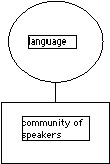
community of speakers [masse parlante] is necessary. Contrary to
all appearances, language never exists apart from the social fact,
for it is a semiological phenomenon. Its social nature is one of its
inner characteristics. Its complete definition confronts us with two
inseparable entities, as shown in this drawing:
But under the conditions described language is not living--it
has only potential life; we have considered only the social, not the
historical, fact.
3) The linguistic sign is arbitrary; language, as defined, would
therefore seem to be a system which, because it depends solely on a
rational principle, is free and can be organized at will. Its social
nature, considered independently, does not definitely rule out this
viewpoint. Doubtless it is not on a purely logical basis that group
psychology operates; one must consider everything that deflects
reason in actual contacts between individuals. But the thing which
keeps language from being a simple convention that can be modi-
fied at the whim of interested parties is not its social nature; it is
rather the action of time combined with the social force. If time
is left out, the linguistic facts are incomplete and no conclusion
is possible.
If we congidered language in time, without the community of
speakers--imagine an isolated individual living for several cen-
turies‹we probably would notice no change; time would not
influence language. Conversely, if we considered the community
of speakers without considering time, we would not see the effect
of the social forces that influence language. To represent the actual
facts, we must then add to our first drawing a sign to indicate
passage of time: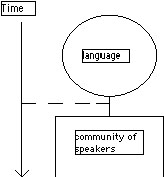
Language is no longer free, for time will allow the social forces
at work on it to carry out their effects. This brings us back to the
principle of continuity, which cancels freedom. But continuity
necessarily implies change, varying degrees of shifts in the relation
ship between the signified and the signifier.
(from Saussure's Course in General Linguistics (Phil Library, 1966) pp. 65-78.)