Leopard
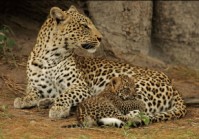 The leopard ( Panthera pardus) is a member of the Felidae family and the smallest of the four "big cats" in the genus Panthera; the other three are the tiger, lion and jaguar. Once distributed across southern Asia and Africa, from Korea to South Africa, the leopard's range of distribution has decreased radically over time due to hunting and loss of habitat, and the leopard now chiefly occurs in sub-Saharan Africa. There are fragmented populations in Pakistan, India, Indochina, Malaysia, and China. Due to the loss of range and continual declines in population, the cat has been downgraded to "Near Threatened" species; its numbers are greater than that of the other Panthera species, all of which face more acute conservation concerns.
The leopard has relatively short legs and a long body, with a large skull. Physically, it most closely resembles the jaguar, although it is usually smaller and of slighter build. Its fur is marked with rosettes which lack internal spots, unlike those of the jaguar. Leopards that are melanistic, either completely black or very dark in coloration, are one of the big cats known colloquially as black panthers.
The species' success in the wild owes in part to its opportunistic hunting behaviour, its adaptability to a variety of habitats and its ability to move at up to approximately 58 kilometres (36 miles) an hour . The leopard consumes virtually any animal it can hunt down and catch. Its preferred habitat ranges from rainforest to desert terrains. Its ecological role and status resembles that of the similarly-sized cougar in the Americas.
Etymology
The leopard ( Panthera pardus) is a member of the Felidae family and the smallest of the four "big cats" in the genus Panthera; the other three are the tiger, lion and jaguar. Once distributed across southern Asia and Africa, from Korea to South Africa, the leopard's range of distribution has decreased radically over time due to hunting and loss of habitat, and the leopard now chiefly occurs in sub-Saharan Africa. There are fragmented populations in Pakistan, India, Indochina, Malaysia, and China. Due to the loss of range and continual declines in population, the cat has been downgraded to "Near Threatened" species; its numbers are greater than that of the other Panthera species, all of which face more acute conservation concerns.
The leopard has relatively short legs and a long body, with a large skull. Physically, it most closely resembles the jaguar, although it is usually smaller and of slighter build. Its fur is marked with rosettes which lack internal spots, unlike those of the jaguar. Leopards that are melanistic, either completely black or very dark in coloration, are one of the big cats known colloquially as black panthers.
The species' success in the wild owes in part to its opportunistic hunting behaviour, its adaptability to a variety of habitats and its ability to move at up to approximately 58 kilometres (36 miles) an hour . The leopard consumes virtually any animal it can hunt down and catch. Its preferred habitat ranges from rainforest to desert terrains. Its ecological role and status resembles that of the similarly-sized cougar in the Americas.
Etymology
Mitochondrial DNA
 In antiquity, it was believed that a leopard was a hybrid of a lion and a panther, as is reflected in its name, a Greek compound of leon ("lion") and pardos ("male panther"), the latter related to Sanskrit padaku ("snake, tiger, panther").
A panther can be any of several species of large felid; in North America, the term refers to cougars; in South America, jaguars; and everywhere else, it refers to leopards.
Felis pardus was one of the many species described in Linnaeus's 18th-century work, Systema Naturae.
Like all of the feline family, the Panthera genus has been subject to much alteration and debate and the exact relations between the four species (as well as the clouded leopard and snow leopard) have not been effectively resolved. DNA evidence shows that the lion, tiger, leopard, jaguar, snow leopard, and clouded leopard share a common ancestor nearly 11 million years ago (Ma)-the basal divergence amongst the Felidae family. The fossil record points to the emergence of Panthera just two to 3.8 million years ago.
In a mitochondrial DNA study, Yu and Zhang (2005) suggest that the leopard is most closely related to the snow leopard, and go so far as placing the latter as a fifth species of Panthera, P. uncia. Canonical works, such as the Mammal Species of the World, continue to list the snow leopard as the only species within its genus, Uncia uncia, but this could change; Johnson et al. (2006) support the placement of the snow leopard within Panthera. They suggest, however, that the snow leopard is most closely aligned with the tiger. The leopard is held to have diverged from the Panthera lineage subsequent to these two species, but before the lion and jaguar. Older research has tended to suggest that the leopard is most closely related to the lion and/or the jaguar. As recently as 2001, it was held to have split along with the lion in a phylogenetic analysis of chemical secretions amongst cats.]
Panthera is believed to have emerged in Asia, with ancestors of the leopard and
other cats subsequently migrating into Africa. Fossil evidence of leopard ancestors has been
found from 2 to 3.5 Ma. These Pleistocene specimens resemble primitive jaguars. The modern
leopard type is suggested to have evolved in Africa 470,000-825,000 years ago and
radiated across Asia 170,000-300,000 years ago.
In antiquity, it was believed that a leopard was a hybrid of a lion and a panther, as is reflected in its name, a Greek compound of leon ("lion") and pardos ("male panther"), the latter related to Sanskrit padaku ("snake, tiger, panther").
A panther can be any of several species of large felid; in North America, the term refers to cougars; in South America, jaguars; and everywhere else, it refers to leopards.
Felis pardus was one of the many species described in Linnaeus's 18th-century work, Systema Naturae.
Like all of the feline family, the Panthera genus has been subject to much alteration and debate and the exact relations between the four species (as well as the clouded leopard and snow leopard) have not been effectively resolved. DNA evidence shows that the lion, tiger, leopard, jaguar, snow leopard, and clouded leopard share a common ancestor nearly 11 million years ago (Ma)-the basal divergence amongst the Felidae family. The fossil record points to the emergence of Panthera just two to 3.8 million years ago.
In a mitochondrial DNA study, Yu and Zhang (2005) suggest that the leopard is most closely related to the snow leopard, and go so far as placing the latter as a fifth species of Panthera, P. uncia. Canonical works, such as the Mammal Species of the World, continue to list the snow leopard as the only species within its genus, Uncia uncia, but this could change; Johnson et al. (2006) support the placement of the snow leopard within Panthera. They suggest, however, that the snow leopard is most closely aligned with the tiger. The leopard is held to have diverged from the Panthera lineage subsequent to these two species, but before the lion and jaguar. Older research has tended to suggest that the leopard is most closely related to the lion and/or the jaguar. As recently as 2001, it was held to have split along with the lion in a phylogenetic analysis of chemical secretions amongst cats.]
Panthera is believed to have emerged in Asia, with ancestors of the leopard and
other cats subsequently migrating into Africa. Fossil evidence of leopard ancestors has been
found from 2 to 3.5 Ma. These Pleistocene specimens resemble primitive jaguars. The modern
leopard type is suggested to have evolved in Africa 470,000-825,000 years ago and
radiated across Asia 170,000-300,000 years ago.
(http://en.wikipedia.org/wiki/Leopard)