May 10th, Feast of St. Job
In the land of Hus, St. Job, Prophet, a man of wonderful patience. (from The Roman Martyrology)
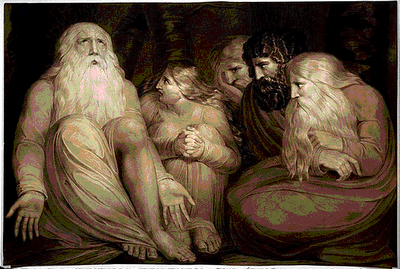 While it is not uncommon to hear modern biblical “scholars” question the historicity of the book of Job and of Job himself, there can be no doubt that the Bible presents Job as a real historical person.
Not only is this the opinion of the Church Fathers and Doctors, but it is also affirmed by other passages of the Scriptures. Further, the Latin Church has traditionally kept the feast of St. Job today. The Greeks keep it on May 6.
Does it matter whether Job really existed?
To this point, the Angelic St. Thomas offers the following reflection:
“But there were some who held that Job was not someone who was in the nature of things, but that this was a parable made up to serve as a kind of theme to dispute providence, as men frequently invent cases to serve as a model for debate. Although it does not matter much for the intention of the book whether or not such is the case, still it makes a difference for the truth itself. This aforementioned opinion seems to contradict the authority of Scripture. […] Therefore one must believe that the man Job was a man in the nature of things.”
With his typical clarity, the Common Doctor points out that, though the argument of the book of Job (which is to show that God’s providence is over all things) does not depend on the historicity of the events narrated nor even on the reality of Job himself, yet the question is of great importance “for the truth itself”.
In other words, it is good to know whether or not Job is a saint or merely a parable. Further, as the Angel of the Schools aptly indicates, the Scriptures themselves seem to indicate that Job truly existed in history. And, since the Bible is inerrant, we must believe that Job really did exist.
Job as an historical person
There was a man in the land of Hus, whose name was Job, and that man was simple and upright, and fearing God, and avoiding evil. (Job 1:1)
There is nothing in the description of the figure of Job which would make us think that he was not an historical person. Indeed, though one may hold that the various dialogues and discussions in the book of Job are stylized and that the work is not a word-for-word transcript, we most certainly need not conclude from this that none of the characters (especially Job himself) even existed!
You have heard of the patience of Job, and you have seen the end of the Lord, that the Lord is merciful and compassionate. (James 5:11)
Here, the Apostle James calls to mind the example of Job, presenting him as an historical person whose virtue ought to be emulated. Again, he is presented as being a real historical person, not merely a literary invention.
Now this trial the Lord therefore permitted to happen to him, that an example might be given to posterity of his patience, as also of holy Job. […]For as the kings insulted over holy Job: so his relations and kinsmen mocked at his life. (Tobit 2:12,15)
This is a citation from the Latin text of Tobit (which was received at the Council of Trent), but the Greek manuscripts which have come down to our day lack these references to Job. In this book, Tobit is compared to Job – and since Tobit was an historical figure, we are led to conclude the same of Job.
And if these three men, Noe, Daniel, and Job, shall be in it: they shall deliver their own souls by their justice, saith the Lord of hosts. (Ezekiel 14:14)
Here, and again in Ezekiel 14:20, Job is mentioned together with Noah and Daniel. Since both of these men are historical, we are led to conclude the same of Job.
The book of Job itself, together with three other biblical books, presents Job as being an historical figure. There is no reason to suppose otherwise. Further, given that the Fathers are unanimous in considering Job to be a real and historical person, Catholic scholars ought not feel to free to teach the contrary.
Who was Job?
The Angelic Doctor declines from going into detail regarding the particulars of Job’s state and life:
“However, as to the epoch in which he lived, who his parents were or even who the author of the book was (that is, whether Job wrote about himself as if speaking about another person, or whether someone else reported these things about him), is not the present intention of this discussion.”
St. Gregory the Great, after insisting that questions regarding the identity of the human author of the book are really not that important, since it is most certainly the Holy Spirit who is the primary author of every book of the Bible, does suggest that it was more probably Job himself who authored the book (rather than Moses or one of the prophets).
Beyond his name – which could be related to the Hebrew word for “persecuted”, but this is dubious – we know very little about Job. Certainly, he began and ended a wealthy man; and it is probably on this account that he is sometimes honored as a king (together with his three friends, who are explicitly called “kings” in Tobit 2:15).
It is also important to recognize that he was a Gentile, and probably from a time prior even to Moses. Thus, the book of Job could be one of the oldest books of the Old Testament – perhaps even the very oldest (since Moses is honored as the author of the books of the Pentateuch).
Where was he from?
The opening verse tells us that Job was from the land of Hus or Uz, which may have been in or near the land Edom. We are told that Job was among the people of the east (Job 1:3).
From this, we can be certain that Job was neither a Jew nor a practitioner of the Jewish religion. Still, he believed in the one true God, through an interior illumination of grace.
[some sources, namely the LXX, identify Job with King Jobab of Edom (cf. Genesis 36:33), but this is highly unlikely]
Why is he called a prophet?
Finally, we recognize that the Church honors Job not only as a man of patience, but as a prophet. This may be surprising, since the book of Job is not generally considered a book of prophesy, but is joined to the so-called “sapiential writings” or “wisdom books”.
Job makes several prophetic utterances throughout the book, but the most significant of all is his explicit affirmation of the resurrection of Jesus and of our future resurrection. Here is the English translation of the Latin Vulgate (and there is much textual debate about which Hebrew manuscripts are most reliable):
Who will grant me that my words may be written? Who will grant me that they may be marked down in a book? With an iron pen and in a plate of lead, or else be graven with an instrument in flint stone. For I know that my Redeemer liveth, and in the last day I shall rise out of the earth. And I shall be clothed again with my skin, and in my flesh I will see my God. Whom I myself shall see, and my eyes shall behold, and not another: this my hope is laid up in my bosom. (Job 19:23-27)
In addition, Job affirms that he has received a vision of the Savior:
With the hearing of the ear, I have heard thee, but now my eye seeth thee. (Job 42:5)
Furthermore, the patient forbearance of Job is a tangible sign and foreshadowing of the sufferings which the innocent Jesus would bear for our salvation.
St. Job, Prophet of the Resurrection, Pray for us!